Edge intelligence · IHCI 2026 · Paper 106
Raspberry Pi 5 Engineering Assistant
A course assistant that makes its sources and calculation steps visible.
Electrical and Electronic Engineering
University of Nottingham Ningbo China
Accepted for oral presentation at IHCI 2026. Paper available as the September 2026 camera-ready author’s version.
Seven configurations compared using a GPU reference; mean rubric scores on a 0–1 scale.
Base + Tools; 54 of 96 answers met the study’s fully-correct criterion.
Closed-book Base only. This is a different configuration, not a matched hardware comparison with Base + Tools.
Project overview
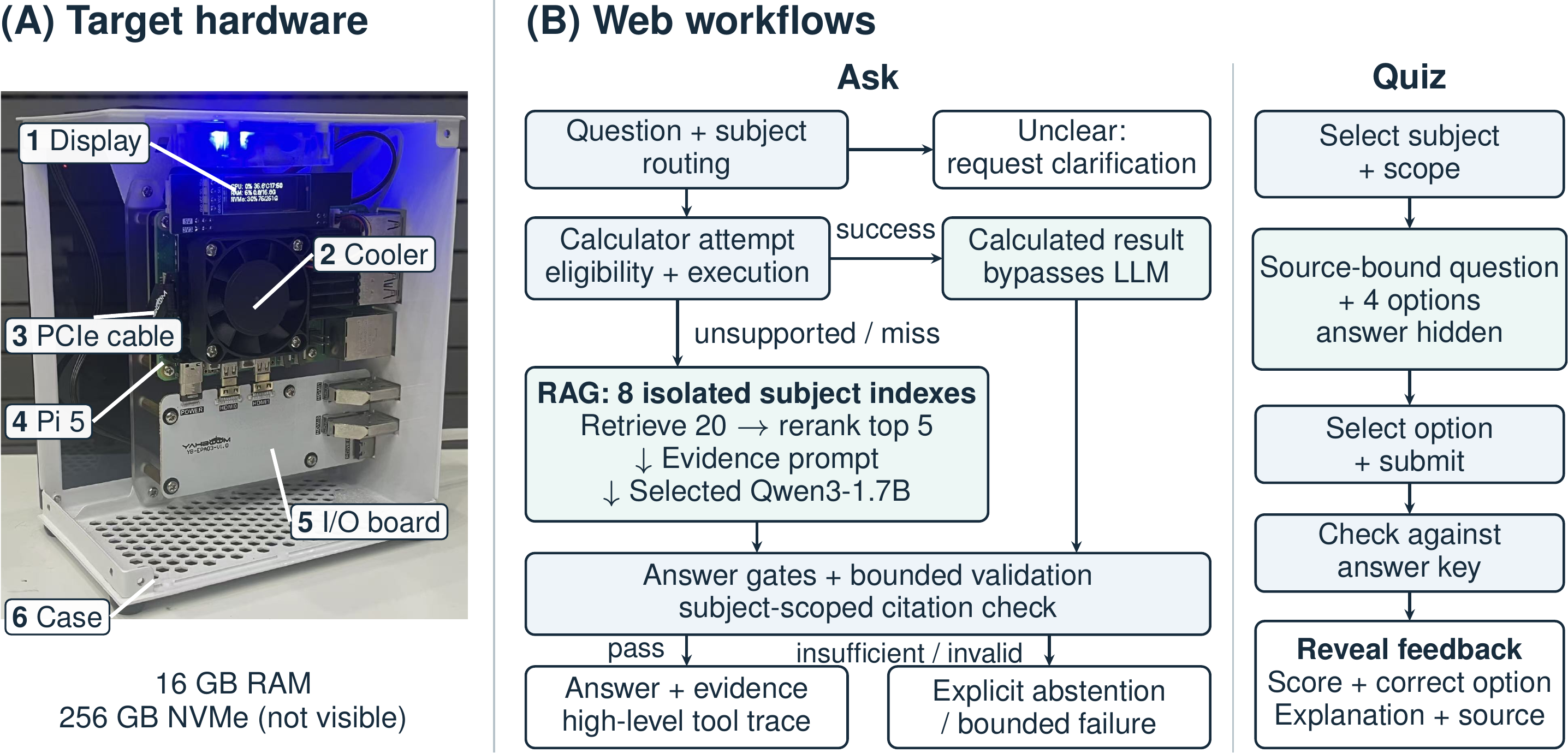
A compact language model can give a fluent answer while using the wrong material or making an arithmetic error. This prototype pairs a four-bit Qwen3-1.7B model with course-material retrieval and deterministic calculation tools.
Ask shows an answer alongside its sources or calculation trace. Quiz reveals feedback and supporting sources after an answer is submitted. The platform targets a Raspberry Pi 5; the reported evaluation separates its components and devices.
Results and scope
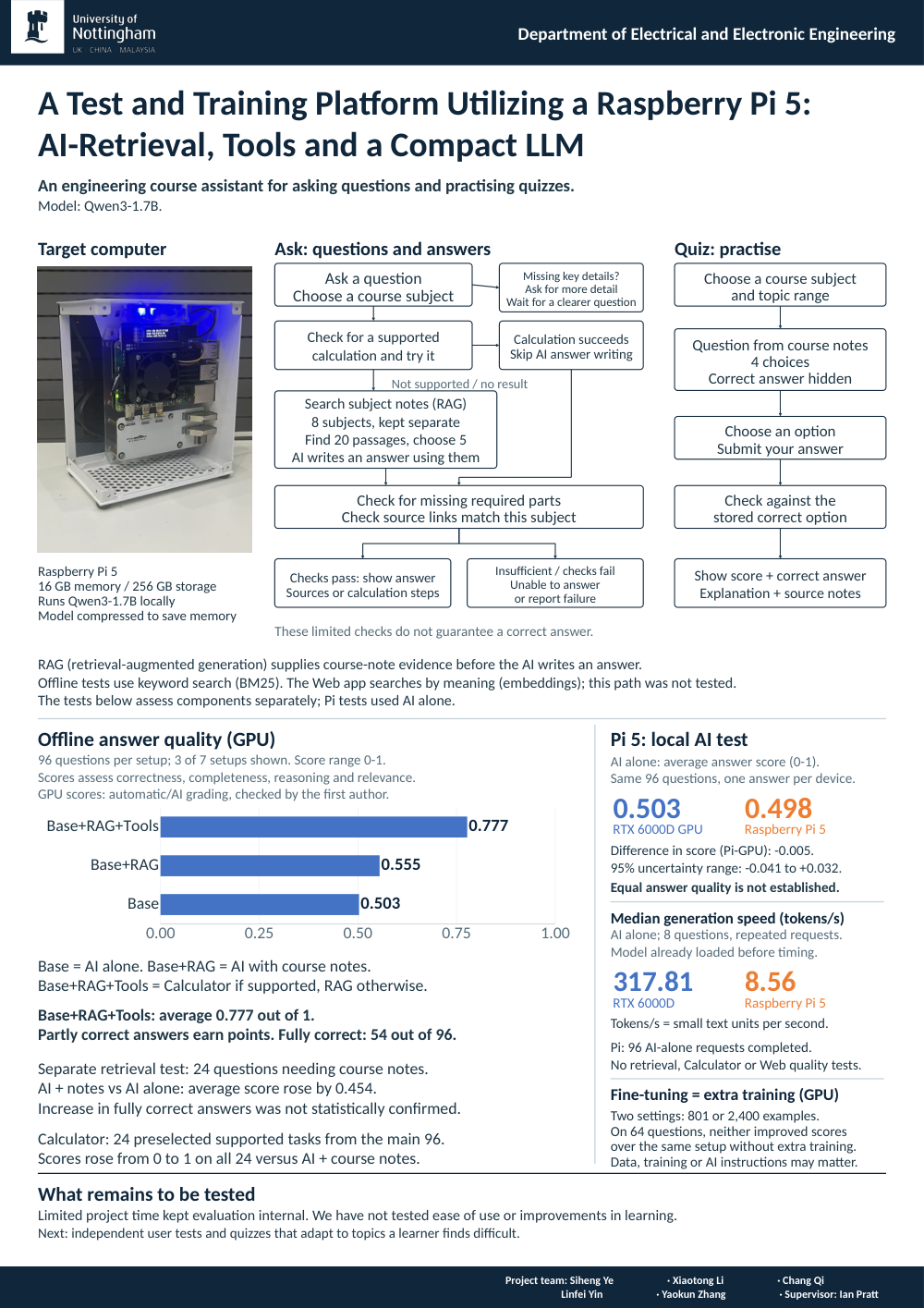
The main evaluation compared seven configurations on 96 EEE questions using an offline GPU reference. The table reports mean rubric scores on a 0–1 scale and the number of answers meeting the study’s fully-correct criterion.
| Configuration | Mean rubric score | Fully correct |
|---|---|---|
| Base (closed-book) | 0.503 | 28 / 96 |
| Base + RAG | 0.555 | 34 / 96 |
| Base + Tools | 0.777 | 54 / 96 |
| Initial SFT (closed-book) | 0.438 | 25 / 96 |
| Initial SFT + Tools | 0.750 | 52 / 96 |
| Expanded SFT (closed-book) | 0.408 | 21 / 96 |
| Expanded SFT + Tools | 0.584 | 39 / 96 |
RAG means retrieval-augmented generation; SFT means supervised fine-tuning. Rubric scores are not accuracy percentages. Base + Tools is the tool-augmented RAG configuration: supported calculations use the deterministic Calculator; other requests use retrieval. The highlighted GPU Base + Tools and Pi closed-book Base results test different configurations and must not be read as a matched hardware comparison.
A separate matched closed-book Base comparison used the same quantised model artefact and 96 questions on both devices: GPU mean 0.503; Pi mean 0.498. The mean difference (Pi − GPU) was −0.005, with a 95% interval from −0.041 to +0.032. The study did not establish equal answer quality.
On a separate 24-question retrieval-sensitive set, Base+RAG scored 0.779 versus 0.325 for closed-book Base (a +0.454 mean change). The Holm-adjusted test for fully-correct outcomes was p = 0.0625, which did not meet the 0.05 threshold. On 24 pre-classified calculator-supported questions, Base+Tools scored +1.000 mean over Base+RAG. Neither tested SFT recipe exceeded its matched Base configuration.
The evaluation used AI-assisted rubric scoring followed by author review, not independent blinded validation. Device observations and selected web demonstrations are separate evidence layers. The study did not test learning benefits, usability or end-to-end web reliability. A displayed source or trace helps inspection but does not itself establish that an answer is correct.
Materials
- PaperPDF · 11 pages · 1.9 MB
September 2026 camera-ready paper: ten original pages, preceded by a version and sharing-terms notice.
- IHCI 2026 presentationPDF · 13 pages · 1.2 MB
13-slide presentation revision from 29 October 2026.
- Submitted FoSE research showcase posterPDF · 1 page · 0.4 MB
The poster submitted on 20 October 2026, with student numbers removed from this public copy.
This author’s version is shared under Springer Nature’s sharing terms . It is not the publisher’s Version of Record.
Open full poster
Public source
The public repository includes the application, retrieval and calculation source, generic examples and setup notes. It excludes private course material, restricted benchmark packets, model weights and deployment configuration. Full Ask/Quiz use requires an authorised corpus, built indexes and a compatible model runtime.
Repository and setup notesResearch record
A Lightweight Test and Training Platform Utilizing a Raspberry Pi 5: AI-retrieval, Tools and a Compact LLM
IHCI 2026 · Paper 106 · Accepted for oral presentation.
This record and its citation follow the IHCI 2026 certificate and official programme. The September camera-ready author’s version retains its original title, “A Test and Training Platform Utilizing a Raspberry Pi 5: AI-Retrieval, Tools and a Compact LLM”. Scheduled session: 30 October 2026, 15:30–16:30 · SS2 · IEB 124 · Ningbo (UTC+8). Proceedings publication, DOI and indexing remain unconfirmed.
Paper abstract
Generic language-model assistants do not naturally align with a particular course. We present a Raspberry Pi 5-targeted platform combining a compact Qwen3-1.7B model, course-grounded retrieval, deterministic calculation, and a Web portal that exposes answers, evidence, and tool execution. It is configurable for individual course requirements; we evaluate system quality and edge deployment, not learning outcomes. GPU-accelerated evaluation compares seven configurations over 96 course questions: closed-book generation, retrieval-augmented generation (RAG), Calculator execution, and two supervised fine-tuning (SFT) recipes. A separate 24-question set compares Base and Base+RAG approaches. Base + Tool-Augmented RAG achieved the highest mean rubric score of 0.777 on a 0–1 scale. Retrieval improved mean source-sensitive quality; deterministic Calculator execution gave the clearest gain on 24 preclassified supported items. Neither SFT recipe demonstrated improvement over its matched Base configuration. A paired 96-question Base comparison did not detect a directional GPU–Pi score difference; the Pi ran the same quantized artifact more slowly.